Le Lapin
"If you’re slow, that’s your fault. Not mine."
History

This page is under construction. Info may change.
Jean-Marie Martin, more commonly known as Le Lapin, was born in the spring of 1863 into a large family on the crowded port streets of Marseille. He lived in a cramped tenement behind a market together with his family as a middle child, and with his parents constantly working, the older siblings raised the younger ones. While some had moved out already, the others worked young. He was fortunate enough to attend a public school, but he performed poorly, sleeping in class, getting terrible marks, distracting other students, and getting into fist fights, resulting in him being expelled.
Being the problem child, he was sent to a religious boarding institution outside the city to be "straightened out". He adjusted poorly at first, but over time began to perform adequately. The rigid routine suited him more than he expected, and while he was never exceptional, his instructors noted steady improvement. For the first time, he appeared on a path toward something resembling stability, even making a few close friends along the way. They often jokingly nicknamed him "Le Lapin", for how fast he could run and for his rabbit-like appearance.
In his teens, he occasionally joined in small mischief with local boys, frequenting brothels and bars, going on small skirmishes and committing petty theft. His mother, as well as two of his younger siblings, later passed away due to cholera, and his father remarried soon after. Le Lapin's own health began to decline after their deaths. Sleepless nights left him irritable and hollow-eyed, he smoked heavily, and his schoolwork deteriorated.
During this period, the eldest of his older brothers still living at home, Nicolas, whom Le Lapin had admired since childhood, secured an apprenticeship and began to earn both respect and independence. Nicolas embodied everything Le Lapin believed he should have been: capable, well-liked, and outwardly successful. Their relationship, once very close, became strained.
One night, Nicolas was drunk and irritable, and accused Le Lapin of wasting opportunities, of bringing trouble down on the family, and of mistaking discipline for progress. The argument took place in the stairwell of their tenement, and quickly escalated. Le Lapin shoved his brother in anger. His brother lost his footing, fell backward, and struck his head against the stone steps. There were no witnesses. At first, Le Lapin believed him only stunned. He tried to wake him, shaking him and calling his name, but there was no response.
Panicked, he dragged the body out of the stairwell and into a more secluded space. Shaken and unsure what to do, he returned home in the dead of night and gathered some his belongings along with some of his brother’s possessions. In his haste, he woke several of his siblings, speaking to them briefly and incoherently before leaving again. By the time the body was discovered, Le Lapin was already gone. He fled toward the docks and hid among the cargo near the port, intending only to avoid being seen until morning. Exhausted and in shock, he fell asleep in the hold of a merchant ship. When he awoke, the vessel had already departed Marseille.
He spent the voyage sick, exhausted and unsure where he was being taken. He cared only that he was no longer in Marseille. He was discovered after two days, but not turned in. The crew forced him to work below deck.
Four weeks passed, and the ship reached New York. Before being handed over to authorities, he managed to escape into the city without knowing a word of English. Convinced Marseille was still too close, his paranoid frenzy continued, and he began heading west.
For nearly half a year he drifted through the unfamiliar country. After taking himself a loose horse on the way, he survived by stealing and taking whatever he could find for a while.
While passing through Illinois, he found work along the rail lines. Even without a shared language, a strong back was understood everywhere. Desperate for money, he sold his horse and shoveled ballast and hauled ties from dawn until dark for about a month, sleeping in canvas tents. His hands split open despite the rags he wrapped them in. When the crew broke up he tried to follow the line west by slipping onto a freight car, but a rail patrol dragged him down before the train departed. Lacking papers, money, or a convincing story, he was locked up on a vagrancy charge and given the choice of time or work. He chose work. The contractor who took him paid near to nothing, set him to the most dangerous cuts, and warned him that running would bring him back in chains. By the time he was released, he was warned not to return.
 Marseille, France French French (Native)
 English (B2/C1)
 Latin (A2)
Somewhere beyond Chicago, he fell in with a handful of men moving westward. They rode beside the lines when they had to, slept beside the treelines and open fields, and ate whatever livestock they could trap or steal. He picked up quite a few words and sentences as he listened to their conversations on the way. However, the group soon began thinning; one found work and stayed, another vanished into a jail cell after a night gone wrong, a third left with their pooled money and did not look back. By the time winter arrived, only Le Lapin and another young man remained, who eventually succumbed to an infected wound. He neither had the will nor strength to bury him, so Le Lapin took the man's horse and rode on, now on his own.
By late winter he reached the Montana Territory. Weakened, frostbitten and riding with several untreated injuries, his horse collapsed under him, cracking a rib in the fall. It was there that Reverend Glasseye found him and carried him into shelter.
Today, he sleeps in the church stables and keeps to a loose routine of small, dubious work. It is enough to get by, though rarely more.
Personality
Le Lapin is known best by the saloon owners and the men who lose their coins to him. He’s not the friendliest face in town, nor the most threatening. People often mistake him for a boy at first glance, which really gets on his nerves. He carries himself with charm, grin ready, arms open, always trying to take up a little more space than he naturally has. His gaze never stops moving, always keeping an eye on the nearest door out. When he speaks, it’s with an accent, often accompanied by his hands. Some consider him a cheeky flirt, others say he swears like a sailor.
Le Lapin often wakes before sunrise, preferring to get his chores, such as cleaning the stable and church, done as early as possible. The later mornings are spent eating with the reverend before making his way downtown. He often does some miscellaneous work, be it writing or reading aloud letters for illiterate townsfolk for a few coins. When he's really low on money, he might do some stable hand work or unload wagons, though he'd leave before he's asked his name. His evenings are spent in the saloons, pickpocketing when he needs to, smooth-talking strangers for a meal or a drink, and now and then joining small gambling circles behind the saloons. He only pickpockets drunkards or rowdy men, refusing to steal from women or anyone that looks worse off than him. He cheats and lies without carrying any real guilt over any of it. He sleeps poorly most nights, either unable to fall asleep or awaking in a cold sweat.
Le Lapin spends a lot of his free time writing. Be it short essays or stories no one will ever read, letters he never sends, fictional conversations, lists of rules, debts, names, lies. Sometimes it's badly organised self-directed studying by copying passages from books or newspapers and correcting or arguing with them in the margins, or trying to reconstruct lessons from school from memory, be it scientific ideas half-remembered, bits of philosophy, or math. His handwriting is a scribbled mess only he can read.
He has a strange fascination with death and endurance, often watching public hangings from the edges of the crowd, less drawn to the spectacle than to the process itself. Privately, he tests his own tolerance for pain in small, controlled ways, pressing injuries or exposing himself to discomfort as if measuring how much he can bear without breaking. Alongside this runs a persistent fixation on the sea. Having grown up among docks and shipyards, he is drawn to the sound and smell of the water and often imagines distant crossings, particularly the long passage across the Pacific, which he envisions in restless, recurring dreams. The sea represents both escape and inevitability to him—an expanse that promises movement, erasure, and the possibility of beginning again.
He cares about how he looks, at least to a point. He keeps himself reasonably clean and put-together. Stress sends him reaching for a cigarette, or pacing circles, or tapping his foot restlessly against the floorboards. Even in private, he’s rarely still.
When praised, he reacts poorly. He deflects with humor, sarcasm, or self-insult, even going as far as to sabotage the praised behaviour afterward. When upset, he becomes crueler, almost surgical with his humor, provoking others into overreacting, even engaging in self-destructive behaviour such as reckless theft. When it turns violent, he ducks, runs, pleads, does whatever it takes to slip away before fists or steel find him. What he fears most isn’t pain, it’s powerlessness. Being pinned or held or silenced, dying under someone else’s hand unable to move.
He tries to hide himself behind jokes, chatter, anything that keeps the world from seeing the tremble behind his grin. What he wants is simple: to be treated like an equal. Not a child, not a street rat, not a joke. On the rare occasion someone speaks to him eye to eye, he tends to grow jealous and uneasy without meaning to, half-convinced they’ll turn on him or leave him behind. And yet, for all his stealing and lying, Le Lapin is still here. Still running, still talking, still making himself larger than he feels, determined not to be swallowed whole by a world that doesn’t expect much from a small young man with a crooked smile.
Relationships
Family
Living Conditions
Appearance
NOTE: Some details may sometimes be omitted for the sake of simplification when drawing him.
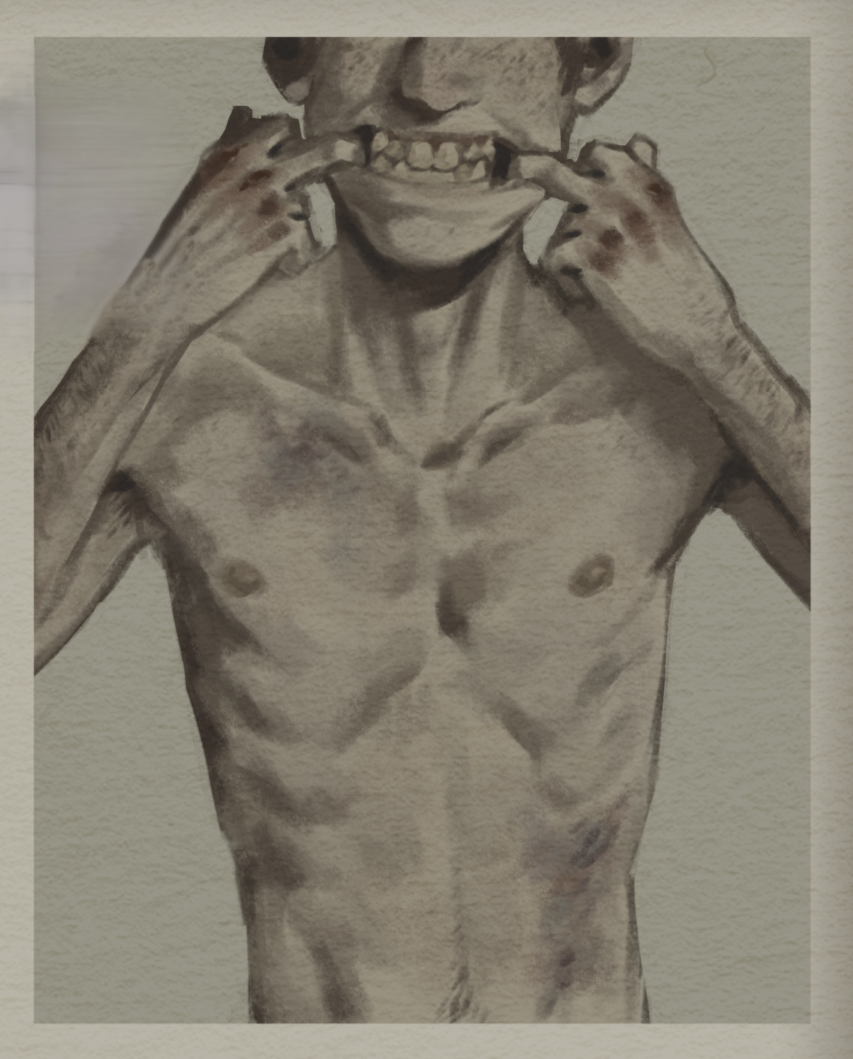
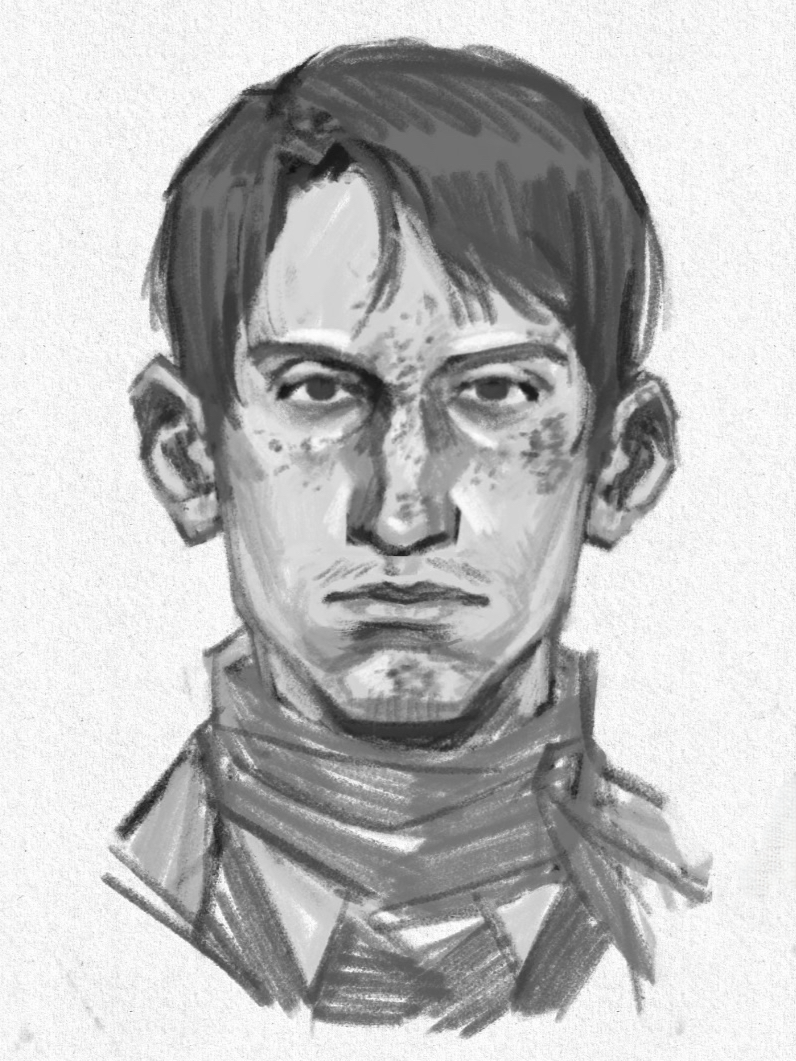
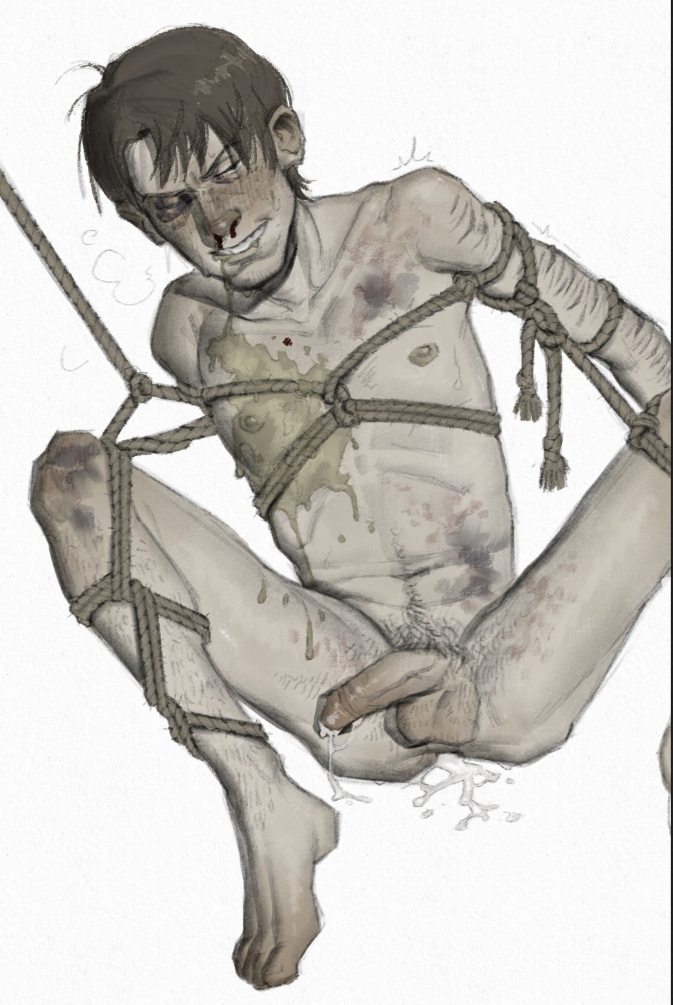
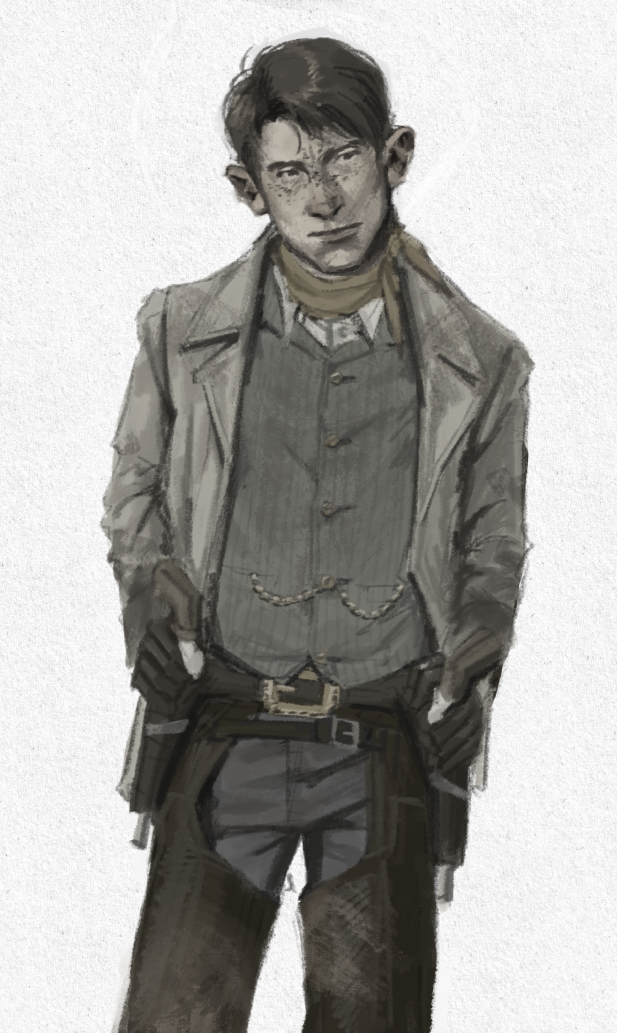
Le Lapin is a short young man, standing around 163 cm (5’4”). He has a very slender boxy build, being partially underweight. His skin is fair and freckled, especially across his mid-face and shoulders. His hair is short, and dark brown, usually parted to the side with a spiky fringe. He has a large amount of scattered cutting scars across his left arm and shoulder, as well as a scar across his chest from an infected broken rib wound, and a few mottled frostbite scars on his chin, nose, and left cheek.
His face is thin and angular, with a slight overbite and large ears that stick out at the sides. His nose is upturned, and his teeth are noticeably crooked, with the two front ones especially prominent. He is occasionally seen with light stubble.
He typically wears a simple black hat, a yellow bandana, and a beige jacket. Under it, he wears a grey-green vest, sometimes with a single gold pocket watch attached, and a plain white button-up shirt. He wears blue jeans with a brown pair of chaps over them, along with a black gunbelt with a holster and a gold buckle. Lastly, he has a pair of black gloves, black boots with a tucked in knife, and gold spurs.
Mount and Weapons

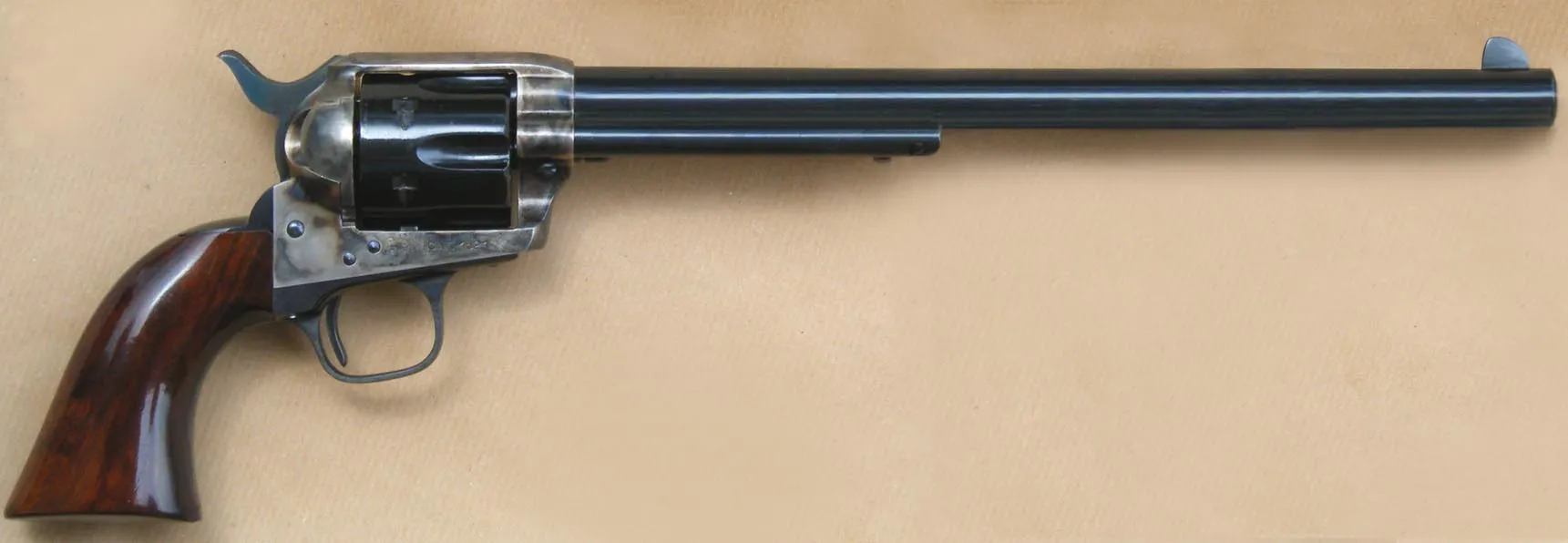
Le Lapin carries a Colt Single Action Army with a
custom 30 cm (12") barell.
(picture is of a Buntline Special, not SAA. Used only to show the barell length.)
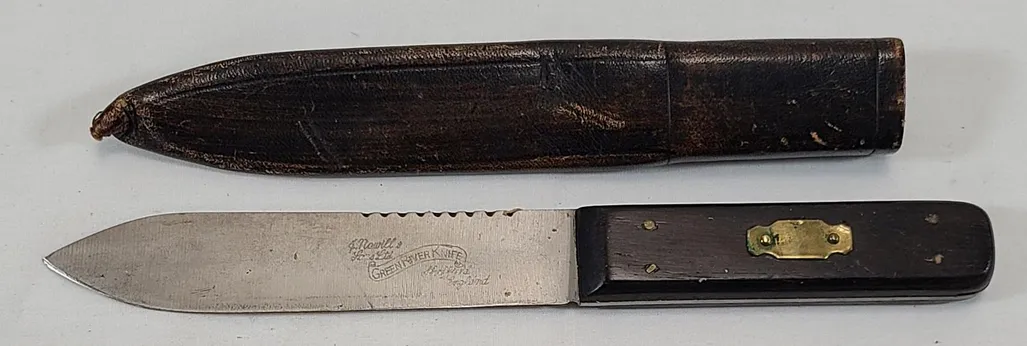
Le Lapin has a trade knife tucked in his boot.
Trivia
Gallery
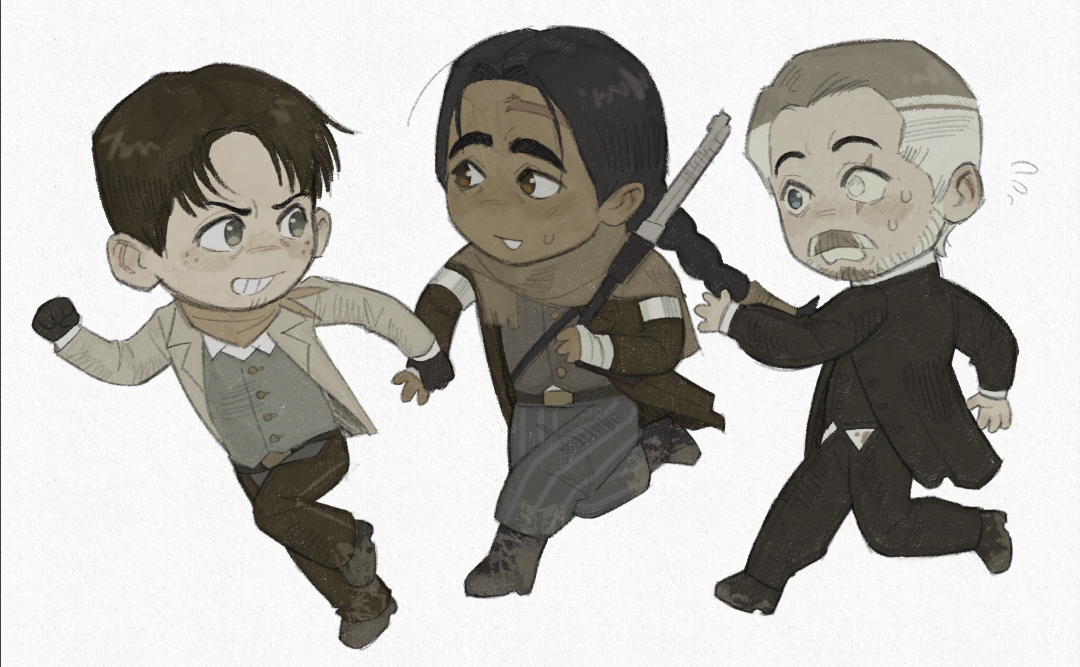
Reverend Glasseye / Rawhide / Le Lapin

Le Lapin

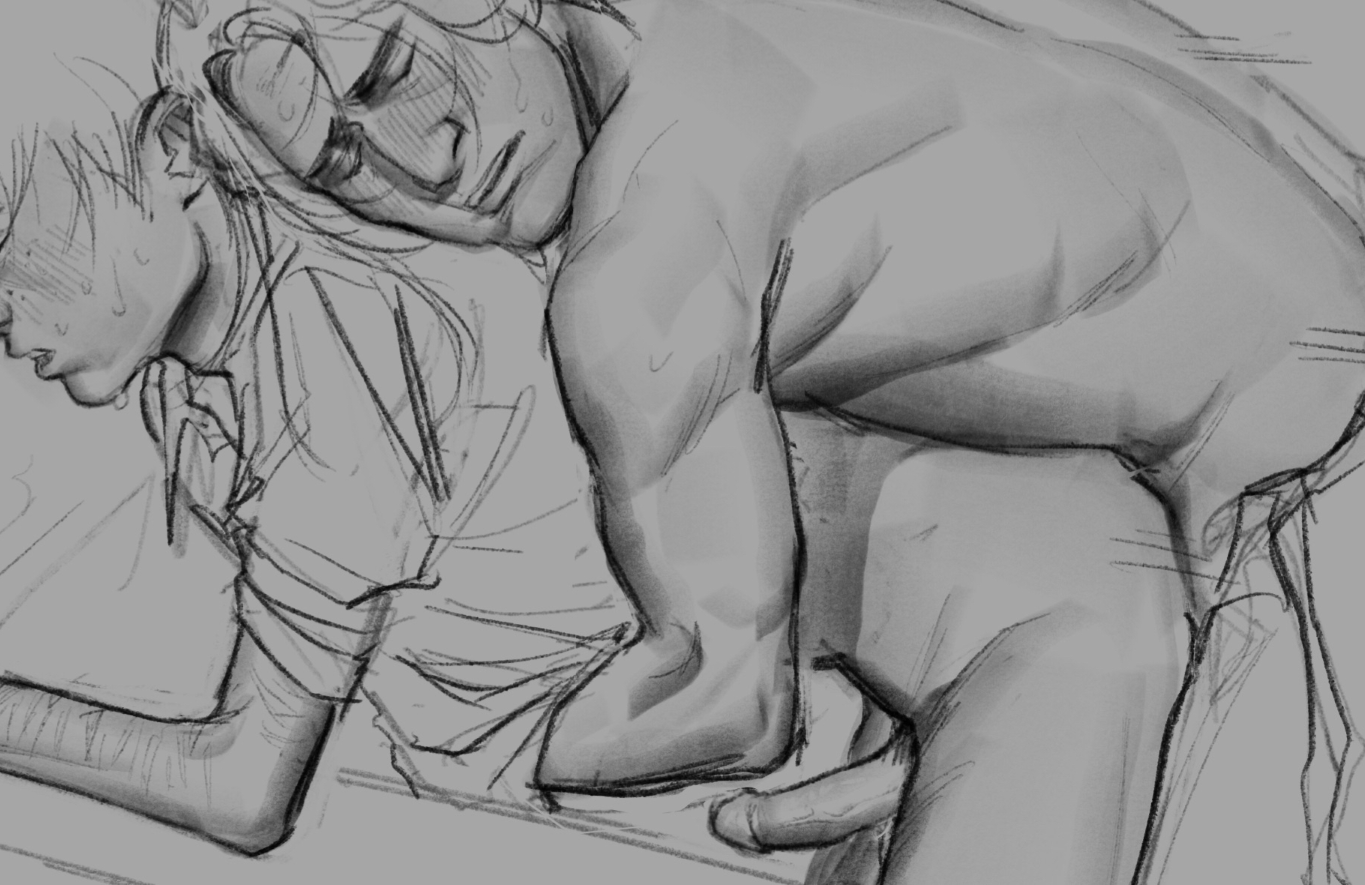
Explicit ⚠
03.01.2026;Le Lapin / Rawhide
Explicit ⚠
02.01.2026;Le Lapin
Le Lapin / Rawhide / Reverend Glasseye
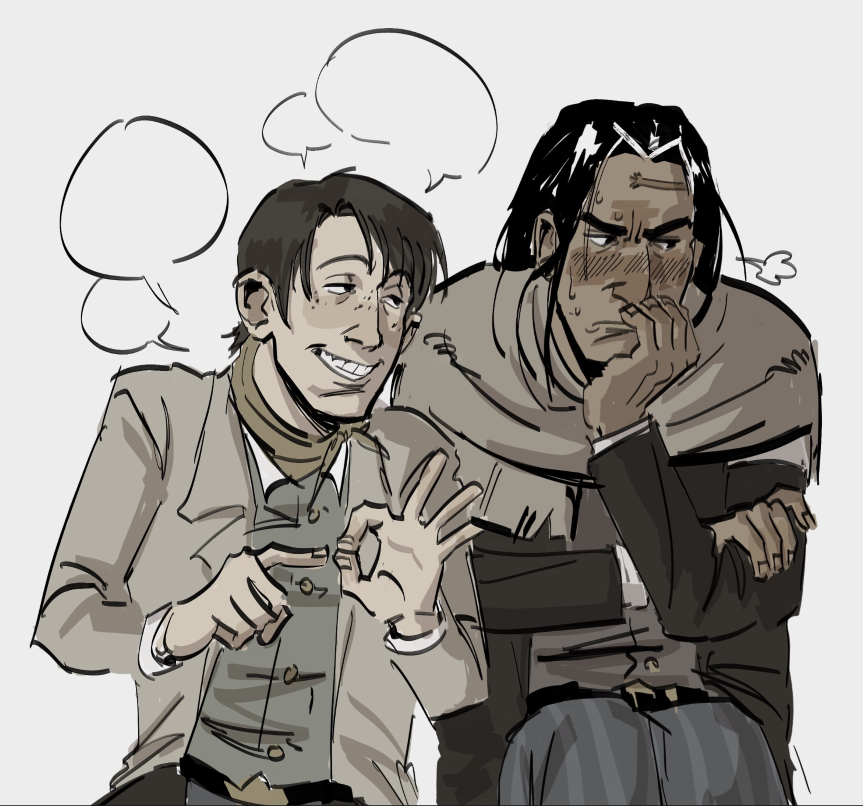
Le Lapin / Rawhide
Le Lapin

Le Lapin / Rawhide / Reverend Glasseye
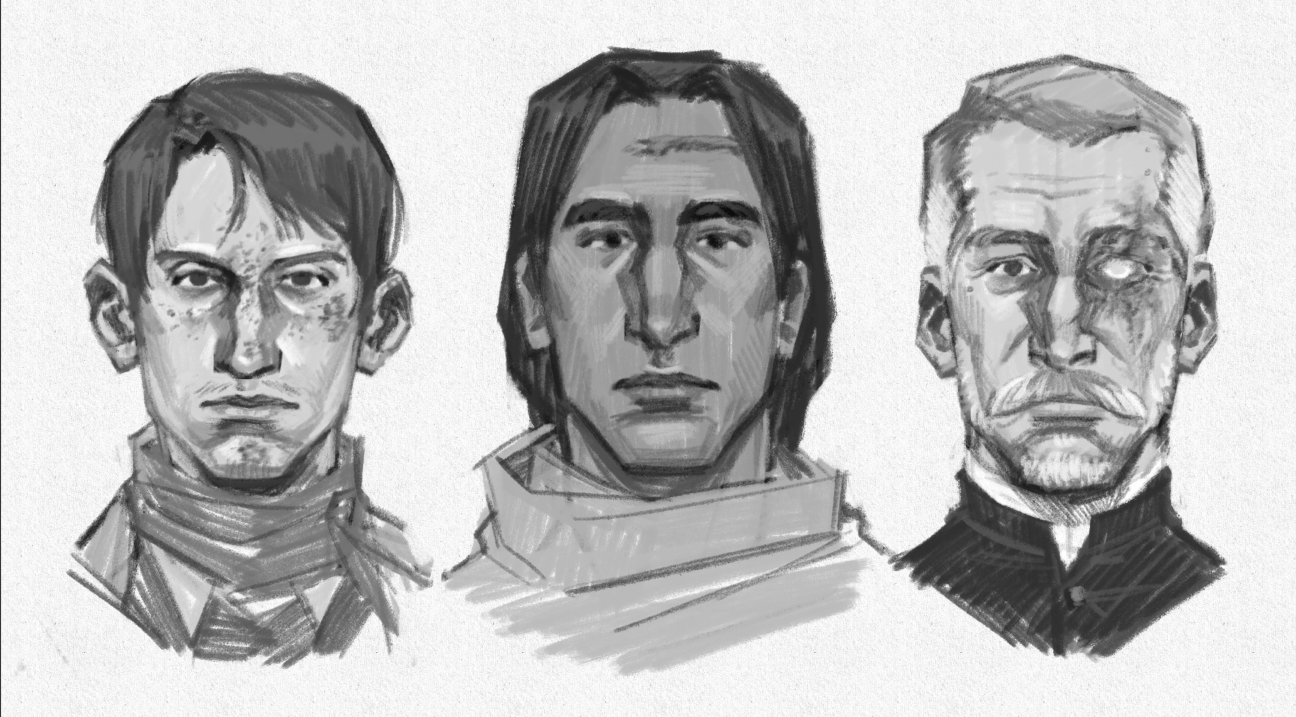
Le Lapin
Explicit ⚠
10.11.2025;Le Lapin / Rawhide

Explicit ⚠
09.11.2025;Le Lapin / Rawhide
Le Lapin